Featured Events
These are the full details for the events we have planned that are coming up in the next few weeks.
If you want to see all the events we have planned this year then take a look at our Programme Page.

These are the full details for the events we have planned that are coming up in the next few weeks.
If you want to see all the events we have planned this year then take a look at our Programme Page.

As she writes on her website, Carol has been obsessed about photography since her 20’s. She honed her skills through years of professional photography, both commercial and wedding, and latterly became a Fujifilm Ambassador.
When she arrived Carol’s first activity was to unpack a mouthwatering array of Fujifilm cameras and lenses – from the relatively cheap but funky X-Half to the top-of-the-range GFX100S II. There was even an example of the almost-mythical X100VI. However even though her talk was called ‘My kit and how I use it’, Carol’s emphasis was on the second part as she has used kit from a wide range of manufacturers.
In the first part of a thoroughly engaging talk Carol covered how she had started photography and what type of photos she makes when she’s shooting for herself. Years of experience have allowed her to visualise a shot without needing to check the framing through a viewfinder, a skill that is useful when shooting on the street. This is something that those who have been on photowalks that she’s led will know about.
One tip she gave to incentivise us to make photos was to start a project. This could be something a simple as, say, the colour red. One of Carol’s projects is called ‘Benches’, which is self-explanatory and an example of which is on the left. There are plenty more, as well as other projects of hers on her website.
Creativity was the theme of her talk after a break for refreshments. This covered the use of different techniques to provide novel ways of approaching photography and introduce new dimensions to image making. Amongst these were ICM and blurring motion, which Carol illustrated with photos that were arresting and thought-provoking.
One of the audience summed up the evening perfectly when she said how inspirational she had found Carol’s talk and photos. She was not alone: many of us went away enthused and encouraged to look out for one of Carol’s photowalks. Thank you, Carol.

In the past WHPC has been fortunate to have had talks by some excellent photographers and Paul is certainly one of them. In collaboration with Spratton Photography Group we were delighted to invite him back to present his talk on Mindful Photography.
Paul is an advocate of slowing down and feeling your surroundings and he points to the positive mental health benefits of photography. He suggests, as photographers, we should slow down and take a more considered approach to our subject.
A strong advocate of practising photography to improve, as if it’s a muscle, Paul advises we shouldn’t beat ourselves up if we don’t think we’re good enough – what you consider is a poor photo may be an inspiration for someone else.
We need to take more time to observe our surroundings and if something draws our attention, we should make a photo of it – don’t wait for another day or it may be gone. Note the word ‘make’, rather than ‘take’. This implies an intention to create something artistically.
Throughout his talk Paul showed us some of his many beautiful images: still lifes, landscapes, ‘ordinary’ objects – each one atmospheric and contemplative. Each photo conveyed more to the viewer than just the subject portrayed, as any good photo should.
Recently his work has been featured in Black and White Photography and Amateur Photography magazines, and his website contains many more photos. His book, Still, is available from Waterstones.
For details of our other forthcoming events take a look at our 2026 Programme page.

For this Knowledge Night we joined forces with Spratton Photography Group and were fortunate to have had a talk by Martine Hamilton-Knight, a renowned architectural photographer and Senior Lecturer at Nottingham Trent University.
Martine has had decades of experience photographing the built environment, a career she started by speculatively sending a photo of Ponds Forge Sports Centre in Sheffield to an architecture magazine.
She explained the main elements to successful architectural photography. As with any photography light is important to show the subject at its best and, unlike landscape photography, clear blue skies help the building to stand out. Viewpoint is crucial to show how the structure sits within its environment, as is a range of focal lengths for wide, medium and detail views.
By their very purpose buildings are made to be used and interacted by and with people. Martine explained how carefully placed figures will bring an otherwise sterile scene to life as well as providing a sense of scale. It is part of an architectural photographer’s job to interact with, persuade and direct people to achieve this.
Throughout her talk Martine provided plenty of beautiful shots of architecturally diverse structures. Many were through commissions from architectural practices and so featured striking modern buildings. However she has also a fine portfolio of more traditional buildings through her collaboration with Yale University Press to update the Nottinghamshire and Staffordshire editions of the Buildings of England books – better known as Pevsners.
The effort that goes into producing photos worthy of their subjects is not insignificant, as Martine illustrated with photos of her considerable collection of tilt-shift lenses and lighting equipment.
Anyone wanting to explore this fascinating branch of photography would do well to obtain Martine’s book Photography for Architects. As an incentive using the code AEVV25 will give a 20% discount until the end of January 2026.
Our thanks to Martine for such an interesting talk and her arresting images. Many of us now know there’s so much more to photographing buildings.
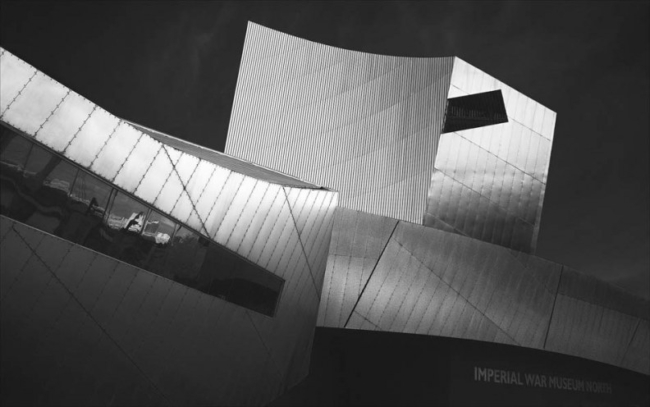
We have been fortunate to have hosted many excellent speakers this year, and this trend continued when we invited Colin Trow-Poole to present his talk ‘People and Places’.
Specialising in strong story telling and, by sensitively using lighting and carefully controlling tonal gradations, Colin produces evocative and thought provoking printed images that may be regarded as ‘Fine Art’. Examples of his atmospheric and inspiring work are on his website.
For places, Colin illustrated his talk with powerful and atmospheric images of and inside buildings, showing how light, layers and thoughtful placing of figures create impact. His series of prints of photos taken in Oradour-sur-Glane, the scene of a terrible massacre, were both poignant and sensitive – the image of the front of a building, its two blank windows and open doorway like a scream, was particularly affecting.
A thoughtful set of prints that Colin had used for his FRPS submission formed the bulk of the people section of his talk. Street portraiture, especially of those less fortunate, can be seen to be exploitative. However, Colin handled this sensitively, showing the humanity of his subjects.
Colin illustrated his talk with prints, rather than projected images, a first for WHPC. This stripped away any vagaries of our projector and the ambient lighting, especially due to the light summer evening. We hope this will encourage our members to print their own work more often – Colin’s offer of 20% off PermaJet paper may also help…
We are indebted to Badby & District Photo Club for their loan of print stands and lightbox enabling us to host this talk.
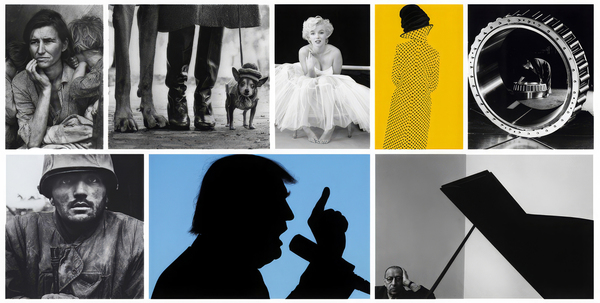
Our first talk this year from an invited speaker was from Derbyshire-based Ashley Franklin, who examined the work of the photographic greats. Ashley explored the story of Portrait, Fashion, Industrial, Travel, War, News, Street & Social Documentary Photography.
The talk was lavishly illustrated by the work of many of the greats of photography, including Avedon, Bailey, Beaton, McCullin, Karsh, Liebovitz and Salgado. Ashley promised ‘an evening of informative, inspiring, powerful and world-changing imagery’, and he certainly delivered.
Ashley’s in-depth knowledge about, and deep respect for, the trailblazers of photography shone through as he took us on a journey from the earliest images in each genre, to the modern masters. It was clear the photos he showed were carefully chosen to illustrate the key shifts in approaches to each of the subjects.
Many of the photos we saw were quite well known, but when examined within the context of photographic development took on extra significance. Some photos were a delight to look at, others were instrumental in bringing about social change. All were inspiring, and at the end of the talk those attending agreed they had learnt a great deal in a very engaging way.
Thanks again to Ashley for his talk and we will look forward to inviting him along for Part Two of his talk.


